
In Part 1, we looked at when a dedicated server makes sense instead of VPS or VDS. In Part 2, we compared the hardware tiers, expected single- and multi-core performance for every CPU option, and system price-performance.
This final part covers server provisioning, validation, handover, upgrades and support.
Many customers choose dedicated servers because they need an entire physical system for a specific workload, higher performance or stricter isolation/security requirements. ServeTheWorld has historically supported such demand through a broad choice of build-to-order configurations, giving customers a wider platform and component range than typical dedicated-server offerings.
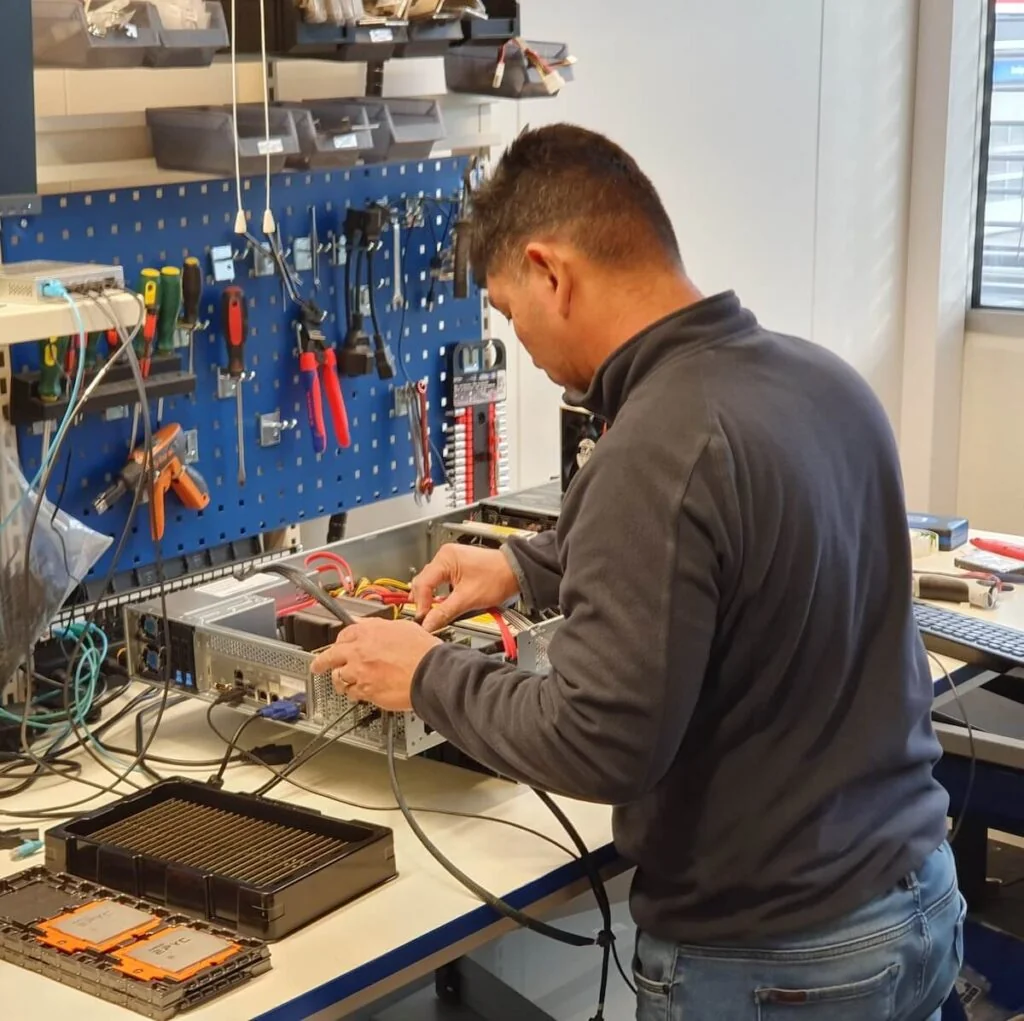
That flexibility helps us differentiate, but it also affects delivery time. Unlike a VPS, which is launched quickly as a virtual machine on our existing Proxmox cluster, a customized dedicated server must be built, provisioned and validated as a separate physical system.
Standard configurations can often be delivered relatively quickly when the parts are available, sometimes in less than a business day. Orders placed late in the day, or outside working hours, may add to the total wait even when the actual build is not complicated. Higher-end or more specific builds generally require more time to deliver, so it can take a few days before the server is validated and handed over to the customer.
For customers who need dedicated compute resources immediately, we also plan to add instant dedicated-server configurations for common workloads. This will complement the build-to-order range rather than replace it.
Ordering process
Our dedicated-server options are broad compared to typical hosting providers. You can choose between different platform families, from high-frequency Ryzen systems to dense latest-generation EPYC configurations, and adjust memory, storage, network and traffic in the configurator.
Across all tiers, the configurator also lets you choose operating system, control panel and backup options, including Linux distributions, Proxmox VE, Windows Server, Plesk and Acronis Backup Cloud where applicable.
Each system tier has its own configurator page, with logic that reflects component choices, platform limits and configurations we can build and support. The configurator also shows an approximate delivery time for the selected configuration.
We normally keep common dedicated-server components in stock, which gives us more control over delivery time and configuration pricing.
If a build requires a component we do not currently have available, or custom parts such as GPUs, specific NICs or storage controllers, we let you know that provisioning will take longer because the missing part has to be ordered.
Customers often email us alongside the order to clarify specific requirements. This is useful for more complex systems, where a short discussion before the build can help confirm the right platform, storage layout, network options or software choices.
For build-to-order dedicated servers, the invoice may be issued during provisioning, but payment is not required before you have had time to check the delivered configuration. We first provide system access so you can confirm that the server matches the order, or contact us if something needs to be adjusted. Future instant configurations will work differently, with payment made immediately upon ordering.
System validation
Once a build-to-order server has been assembled, it goes through functional checks and burn-in testing.
For Linux-based validation, we use stress-ng to stress CPU and memory and observe kernel stability under sustained load. In our process, the burn-in cycle normally runs for around three hours.
This can reveal issues that are not visible during a normal boot or installation: memory errors, unstable components, storage issues, thermal behaviour or insufficient cooling. When testing exposes a problem, we replace or adjust the affected component and validate the system again before handover.
If a drive is recommissioned from previous use, we trigger a controller-level secure erase before the system is prepared for the next customer.
Validation adds time before the server becomes available, but it reduces the chance of discovering hardware-related problems after the customer has installed software, migrated data or moved workloads into production.
Billing and money-back guarantee
Once the server is validated and online, you receive full access before paying, so you can verify the delivered configuration in practice before the subscription begins.
This is especially relevant for higher-end configurations, where customers may want to verify everything before committing to the service.
Dedicated servers are billed in advance as ongoing subscriptions. Customers can choose monthly invoicing, or opt for quarterly or annual invoicing to reduce the frequency of invoice payment and processing.
We also offer a 90-day money-back guarantee for dedicated servers. This makes the first order decision easier, especially for customers ordering from outside Norway.
Traffic overages and server upgrades
Each dedicated server includes 50 TB of total traffic per month, calculated as combined inbound and outbound traffic. Customers who expect higher usage can add fixed-price traffic packs in the configurator, such as 100 TB, 200 TB or 300 TB.
If usage significantly exceeds the selected traffic quota, the excess is billed at a flat rate of 10 NOK per TB. Customers can either choose a larger traffic package in advance or pay the same transparent overage rate for additional usage.
We also let customers upgrade their dedicated servers over time. It is not uncommon to add more memory, expand storage, move to a higher-speed port or adjust the traffic package. Hardware changes are handled through planned downtime agreed with the customer, since the server normally has to be brought offline, modified, checked and returned to service.
CPU upgrades require more caution. Where a CPU change is the right technical path, we can evaluate it. In other cases, moving to another server platform may be safer and more predictable.
We do not normally downgrade an existing dedicated-server subscription in place. If you need a smaller system, the clean approach is to cancel the current server subscription, start a new one and migrate the workload.
Support and responsibility
A dedicated server gives the customer full administrative control. You decide how the operating system, software stack, security model and workload are configured. You also receive practical remote-management access to the machine through an IPMI proxy, so you can access the server console and perform low-level management tasks when needed.
You manage everything inside the operating system and application stack; we manage the physical infrastructure and underlying platform.
ServeTheWorld takes care of data centre operations, power, cooling, network connectivity, server hardware and access infrastructure.
Infrastructure uptime
We guarantee 99.99% uptime on the physical infrastructure we operate. This covers the infrastructure layer around the server, including areas such as network, power and related platform availability.
This is not only a target in the service terms. At the time of writing, this guarantee also reflects our long-term track record since 1999, with only one site-wide downtime event in our history.
We help with service-level tasks such as remote access, reboots, reinstallations, rescue functions and hardware-related issues. The customer remains responsible for the operating system, applications, data and backups unless something else has been agreed.
If help is needed outside the standard scope, we can review what is possible and agree on the work separately.
Closing note
We originally planned predefined bare-metal servers for faster delivery in Q2 2026. During development, we decided to extend the validation phase for the new enclosure design, thermal profile and ordering automation.
The goal remains the same: to offer instant dedicated-server configurations for common workloads, while keeping build-to-order systems available for customers who need more flexibility. The initial instant range is expected to use socket AM5 and is planned as part of our 2026 dedicated-server roadmap. We plan to share more details as the instant range gets closer to launch. Stay tuned.
Part 3 adds an operational angle to the previous architectural decision posts. It does not cover every policy detail. If you did not find the answers you were looking for, the FAQ section and SLA are covering the usual ordering, traffic, billing and service details.
For questions about specific builds, upgrades or migration plans, the best next step is to reach out to us directly. We can review the workload, check the available platform options and suggest a configuration that fits the requirement.
Don’t hesitate to contact us with questions. We are happy to help customers find the right solution, especially when the workload requires extra planning or customization.
Alexey Nechuyatov
Strategic development, ServeTheWorld