
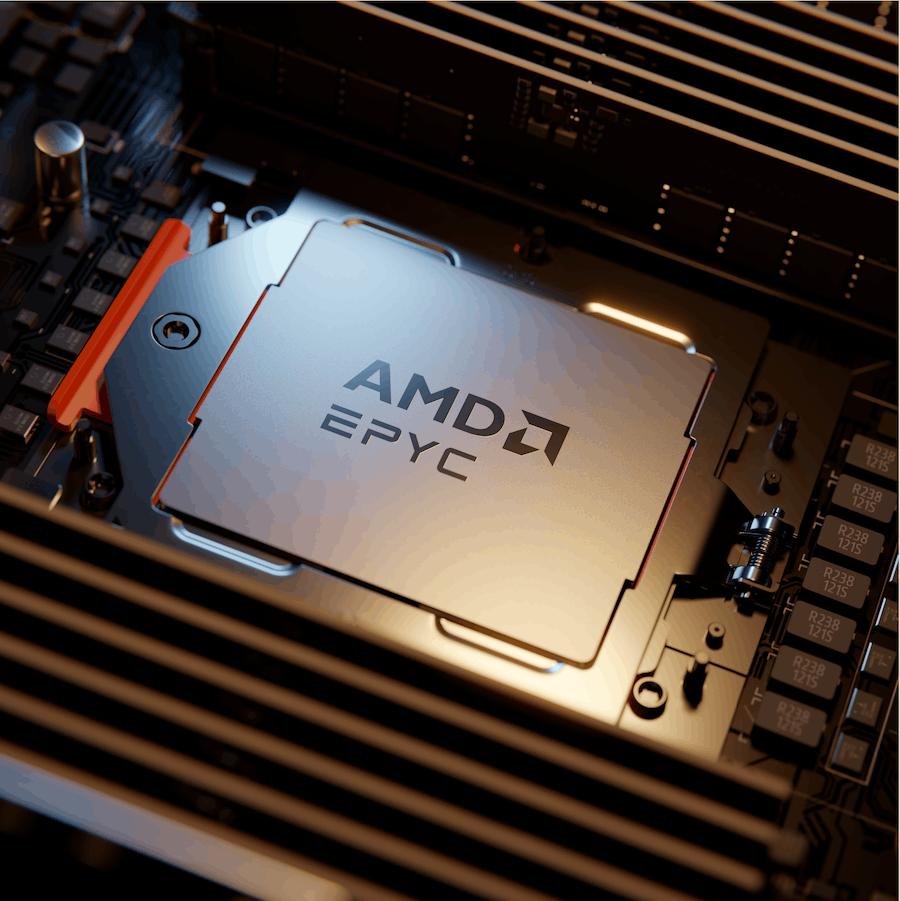
We’ve launched a new VPS family called VD1, sitting alongside our existing GP3 General Purpose VPS on the third-generation VPS platform. Both run Linux on modern AMD hardware in our Oslo data centre. The difference is in how CPU is allocated. On VD1, each vCPU you order gets its own physical CPU core, reserved for your VM. On GP3, cores are shared between VMs in the usual VPS way.
What “Virtual Dedicated Server” means
A normal VPS shares its host’s physical CPU cores between many virtual machines. The hypervisor (the software that runs the VMs) hands out CPU time as each guest needs it. Most of the time this works well, because most workloads don’t need all their CPU all the time. But when two VMs on the same host both want the same core at the same moment, one has to wait, and it adds up if your workload is hammering the CPU steadily.
VD1 removes that problem with 1:1 CPU mapping. Each vCPU you order is backed by its own physical core allocation, and we do not oversubscribe that CPU capacity across customer VMs. That gives you noisy neighbor isolation on the CPU side and the performance consistency you want for any workload that’s CPU-bound for long stretches.
How VD1 differs from GP3
Both VD1 and GP3 run on the same underlying platform. Proxmox VE handles virtualisation, and Ceph provides distributed NVMe storage replicated across nodes for speed and resilience. Each VPS family runs on its own dedicated cluster, built and operated the same way, with live migration between nodes, automatic recovery if a node fails, and the same 99.99% availability target.
But the two families are built for different kinds of work.
GP3 uses AMD EPYC 9474F CPUs with a high all-core boost frequency. Cores are shared, with an upper bound of five vCPUs per physical core across the cluster. The combination of high clock speed and shared scheduling makes GP3 a strong general-purpose host for web servers, development environments, application stacks with mixed or bursty load, and everyday Linux workloads.
VD1 uses AMD EPYC 9734 CPUs at 2.2 GHz base and up to 3 GHz boost. The cores run slower than GP3’s, so GP3 can be the faster option for a quick burst of work, but on VD1 you get the full use of your reserved cores all of the time. VD1 is built around reserved capacity and sustained workloads, where that steady throughput is usually worth more than burst headroom.
A few other practical differences
- More RAM per vCPU. VD1 gives you 4 GB of RAM per vCPU on every plan. GP3 ranges from 2 GB to 4 GB depending on plan size. That higher RAM-per-core ratio matters if your workload is memory-hungry as well as CPU-hungry, because VD1 saves you from over-provisioning cores just to get the RAM you need.
- More included traffic. VD1 includes 35 TB of monthly traffic per VM, against 25 TB on GP3. Extra traffic is billed the same way on both (10 NOK per TB).
- Bigger top end. The largest VD1 plan has 128 GB of RAM at 32 vCPUs. The equivalent GP3 has 64 GB at 32 vCPUs. If you’re running a single big workload rather than several small ones, the bigger ceiling matters.
Getting started
Plan sizes, current pricing, and the full comparison table are on the VD1 plans page. VMs deploy automatically within minutes of ordering.
If you’re weighing GP3 and VD1 for a specific workload and want a second opinion before committing, get in touch. We can help you pick the right family up front.
Aries Atienza
Senior Engineer, ServeTheWorld