
This is the second part in our series on Norway as a hosting location. The first covered Norway’s energy system, including hydropower, grid stability, and why major data-centre operators have invested here. This article turns to the network side: how Norway is connected internationally, what that means for hosting performance, and where the country fits within the wider European connectivity landscape.
Over the past decade, Norway’s network environment has changed significantly. New subsea cables, expanded backbone infrastructure, and a more mature peering ecosystem have made the country far more integrated into the Nordic, European, and transatlantic network environment than its geography alone might suggest.
Latency starts with geography
Norway is located at the northern edge of Europe, and this is reflected in network latency. Typical round-trip times from Oslo to major European hubs are usually higher than from Amsterdam or Frankfurt because the signal has further to travel.
That is the physics of fibre, and why Norway is not the best fit when ultra-low latency to central Europe is the primary requirement. At the same time, many modern workloads are not highly latency-sensitive. Capacity, routing stability, server performance, storage design, and operational reliability often matter just as much as shaving off every millisecond.
While hosting in Norway is particularly well suited for Nordic and Northern European users, its relevance extends beyond the Nordics. For platforms serving mixed European traffic, UK and Ireland traffic, Europe-to-US workflows, or workloads where consistency matters more than ultra-low latency to one central-European hub, Oslo can still be a practical regional hosting location to consider.
Try it yourself
You can test network latency and connectivity directly through Check-Host.cc, a remote network diagnostics platform whose Norway-based node is hosted on our VPS cluster in Oslo.
ServeTheWorld operates this node, allowing users to run live ping, HTTP, TCP, DNS, UDP, and MTR checks from Norwegian infrastructure and compare latency, connectivity, and routing to international destinations.
At the time of writing, we tested our Check-Host.cc node against several international destinations. Helsinki was reachable in around 14–18 ms, Frankfurt in around 22–35 ms, London around 38 ms, and several US locations around 119–141 ms. Individual results vary by route, provider, and time of day, which is exactly why live testing is useful.
International routes and subsea connectivity
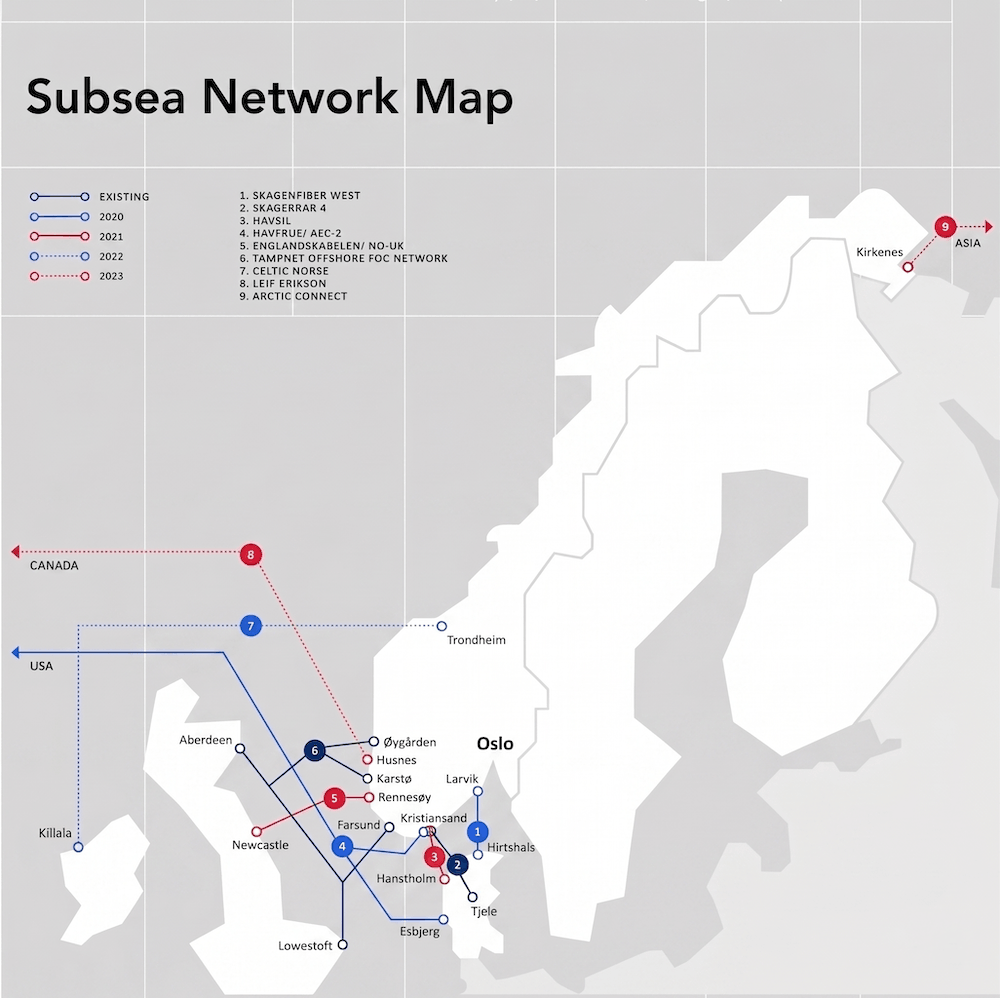
Historically, a large share of Norwegian internet traffic was routed through neighbouring Sweden before reaching continental Europe. That terrestrial route still matters, but Norway’s international connectivity has become more diverse in recent years thanks to additional subsea paths across the North Sea and Skagerrak. The examples below are not an exhaustive inventory, but they illustrate the change.
The HAVSIL subsea cable added a direct high-capacity route from Norway to Denmark, strengthening the country’s path toward continental Europe. [1][2]
The NO-UK cable created a direct connection between Stavanger and Newcastle, adding another North Sea route between Norway and the United Kingdom. [3]
The Havfrue/AEC-2 subsea system adds a transatlantic dimension, linking the US East Coast, Ireland, Northern Europe, and Norway through the broader cable system. [1][4]
Together, these routes improve path diversity, reduce reliance on a single geographic corridor out of the country, and strengthen overall network resilience.[5]
For readers who want to explore these routes visually, Submarine Cable Map provides a useful global overview of subsea cable systems and landing points.
Terrestrial connectivity and peering
Subsea cables are only part of the story. Traffic also depends on terrestrial fibre routes, regional interconnection, and how networks exchange traffic inside Norway and across the Nordics.
NIX, the Norwegian Internet Exchange, operates exchange points across Norway and supports local and regional interconnection for ISPs, content providers, and other networks operating in Norway. [6]
At internet exchanges like NIX, networks can peer directly with each other instead of sending all traffic through upstream transit providers. In practice, this can shorten some routes, improve routing efficiency, and reduce dependence on third-party carriers for regional traffic flows.
Netnod, a Swedish internet exchange and DNS infrastructure operator, has also expanded into Oslo. Its Oslo exchange supports local traffic exchange and extends reach across the Nordics, with access to more than 200 networks across its platform. [7]
Internet routing is always dynamic and depends on commercial relationships, available paths, and congestion. What matters in practice is that Norway now provides a mature interconnection environment for both domestic and international traffic.
For a broader view beyond subsea systems, ITU’s Broadband Maps show terrestrial fibre routes, transmission networks, IXPs, nodes, and data centres.
Major carriers and operators
Norway’s connectivity environment is supported by a mix of domestic operators and international backbone providers.
Telenor remains a central part of Norway’s national telecom and enterprise connectivity landscape, while GlobalConnect operates significant Nordic fibre and transport infrastructure across Norway, Sweden, Denmark, Finland, and Germany.
On the international transit side, Arelion, formerly Telia Carrier, remains one of Europe’s major backbone providers and is part of the wider carrier environment connecting Norway to European and global networks.
For hosting providers and data-centre operators, this carrier diversity enables resilient multi-homed network designs and access to multiple upstream providers.
Our network approach
As we announced in our Q1 update, we recently added a 400 Gb/s uplink to Amsterdam and connected to NIX on a 100 Gb/s port. The Amsterdam link strengthens capacity toward one of Europe’s major peering hubs, while the NIX connection gives us more flexibility for direct regional peering inside Norway and the Nordics.
Being listed at NIX places our network inside Norway’s neutral peering environment, alongside operators and content networks that exchange traffic locally. This gives us more flexibility to establish direct peering where it makes sense instead of relying only on upstream transit.
We continue to invest heavily in our core network platform to support long-term scalability, resilience, and growing international traffic demand.
The STW network at a glance
- Redundant Oslo-based hosting network with multi-carrier upstream connectivity
- More than 700 Gbit/s upstream capacity, with room for multi-terabit expansion
- Typical latency of approximately 25–35 ms to major European hubs, depending on route and destination
- Live testing available through our Norway-based Check-Host.cc node
Conclusion
Norway’s position within the European network environment is still shaped by geography, but geography no longer tells the full story. New subsea cables, expanded fibre infrastructure, improved peering, and greater carrier diversity have significantly strengthened how the country connects to the rest of Europe and beyond.
For readers interested in the broader connectivity landscape, the Norwegian Data Centre Industry Association also offers an overview of Norway’s international connectivity environment.
For workloads that require the absolute lowest possible latency to Frankfurt or Amsterdam, location still matters. But for many hosting use cases, including VPS, dedicated servers, VPN infrastructure, SaaS platforms, backups, analytics, storage, AI workloads, and mixed European traffic, Norway is now a practical and well-connected Northern European option.
Next, in Part 3 of this series, we examine jurisdiction, data sovereignty, and how Norwegian hosting fits into the wider European regulatory environment.
References
- Bulk Infrastructure – Fiber Networks: https://bulkinfrastructure.com/fiber-networks/our-systems
- HAVSIL cable: https://www.submarinenetworks.com/en/systems/intra-europe/havsil
- NO-UK cable: https://www.subseanetworks.com/2021/12/23/no-uk-submarine-cable-system-ready-for-service/
- Havfrue/AEC cable: https://www.submarinenetworks.com/en/systems/trans-atlantic/havfrue
- Norwegian Data Centre Industry – Connectivity: https://www.datasenterindustrien.no/connectivity
- NIX: https://www.nix.no/
- Netnod Oslo: https://www.netnod.se/ix/oslo