
Until now, we have mostly written about our products and services. With this new series, we turn to Norway as a hosting location — explaining to an international audience the broader conditions and practical reasons it works for modern infrastructure.
Norway’s total data-centre capacity has roughly doubled since 2020, from around 150 MW to more than 300 MW — compared with an estimated 40–60% increase across the EU over the same period.[1] This expansion reflects structural conditions that make the country increasingly relevant for power-intensive compute, foremost among them its electricity generation system.
This article outlines how Norway’s geography shaped its energy supply, why that matters for digital infrastructure, and why leading global and Nordic firms — including Microsoft Azure, Google, and OpenAI–Aker–Nscale — have recently invested in new capacity here.
A grid built on hydropower (and some wind)
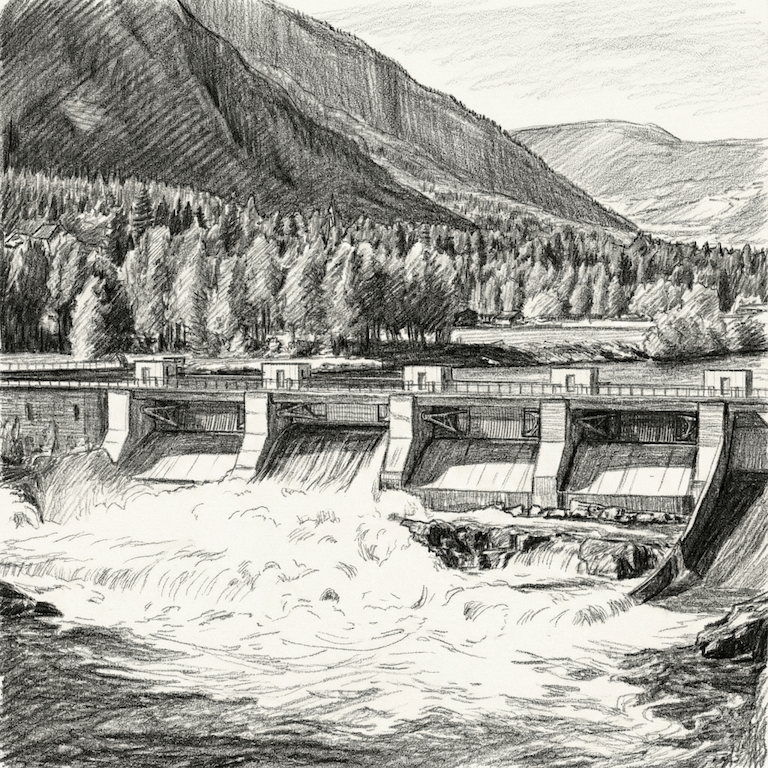
Norway’s energy system is inseparable from its terrain: steep mountains, heavy precipitation, deep valleys, and natural reservoirs create ideal conditions for large-scale hydropower. The discovery of oil in the 1960s financed national electrification and grid investments, but electricity generation itself has always been rooted in landscape rather than fuels.
Today hydropower remains the backbone of the system: a national asset created by geography and enabled by decades of public infrastructure investment.
Norway’s reservoirs allow storage of water over weeks or even seasons, giving the grid an unusual flexibility and supply stability. The country operates around 1,100 regulated water reservoirs with more than 87 TWh total storage capacity, 1,791 hydropower plants at roughly 34 GW installed capacity, and over 60 wind farms.[2] Industrial users — from aluminium smelters to cloud operators — benefit from that same stability today.
In 2023, 95% of electricity consumed came from renewable sources: about 83% hydropower, 11% wind, and 1% solar.[3]
Environmental advantages
Electricity consumed in Norway carried an emissions factor of about 15 g CO₂e per kWh in 2023, compared with the EU average of 213 g CO₂e per kWh in 2024.[3][4] That 14-times lower footprint is highly relevant for organisations reporting Scope 2 emissions or operating under ESG constraints.
The cool, stable climate further reduces power demand by lowering cooling needs. For much of the year, data centres can rely on outside air or water rather than mechanical chillers, enabling consistently low PUE values over time.
Some sites in and around Oslo already reuse server heat in district-heating systems, feeding waste heat into networks that supply nearby residential and commercial buildings and improving overall energy efficiency.
Long-term stability
Power prices in Norway vary with hydrological conditions and European market links, and can be high in dry years, but generation costs remain anchored in domestic, renewable resources. Regulated reservoir management and sustained investment in the national grid provide stable long-term fundamentals, which are essential for planning large-scale compute.
Global operators are expanding
Hyperscalers, AI infrastructure providers, and leading Nordic firms are expanding in Norway for a simple reason: they can secure large amounts of stable, low-carbon electricity and operate efficiently in a cool climate, supported by a mature national grid and long-term infrastructure planning. Their continued investment is itself a signal that these underlying conditions are attractive at scale.
At the same time, grid congestion and long queue times — averaging seven years or more in FLAP-D markets (Frankfurt, London, Amsterdam, Paris, Dublin) — increasingly restrict new capacity elsewhere.[1] Regions like Norway, where spare grid capacity exists, are therefore positioned to absorb a larger share of Europe’s data-centre growth.
Note: The growth of large data-centre projects is also a live public debate in Norway, centred on local value creation and jobs, competing use of grid capacity, and potential impacts on electricity prices. That discussion matters and requires public consensus, but we keep it outside this article to stay focused on the underlying energy and infrastructure conditions.
Summary: key takeaways
- Norway’s data-centre capacity has doubled since 2020, underpinned by extensive hydropower, large reservoir storage, and growing wind capacity.
- The grid’s flexibility, efficiency, and exceptionally low emissions profile make it a strong fit for power-intensive, ESG-conscious workloads.
- Major international and Nordic operators have already established capacity in Norway, signalling confidence in these fundamentals.
- While short-term energy prices fluctuate, long-term power stability and infrastructure resilience position Norway as one of Europe’s most sustainable growth locations for compute.
What comes next
The next articles in this series will explore other factors that shape hosting and colocation in Norway — including network connectivity, data sovereignty, and work culture — as well as some everyday practices that influence how infrastructure is built and operated here.
References
- Ember — Grids for Data Centres in Europe. Relevant sections: Executive summary (p. 2); Grid constraints and connection timelines (pp. 10–12)
https://ember-energy.org/app/uploads/2025/06/Grids-for-data-centres-in-Europe.pdf - Energifakta Norge — Electricity production and installed capacity
https://energifaktanorge.no/en/norsk-energiforsyning/kraftproduksjon/ - NVE — Low greenhouse-gas emissions linked to Norwegian electricity consumption in 2023
https://www.nve.no/nytt-fra-nve/nyheter-energi/lavt-klimagassutslipp-knyttet-til-norsk-stroemforbruk-i-2023/ - Ember — Global Electricity Review (2025).
Relevant sections: Chapter 5 https://ember-energy.org/latest-insights/global-electricity-review-2025/major-countries-and-regions/